
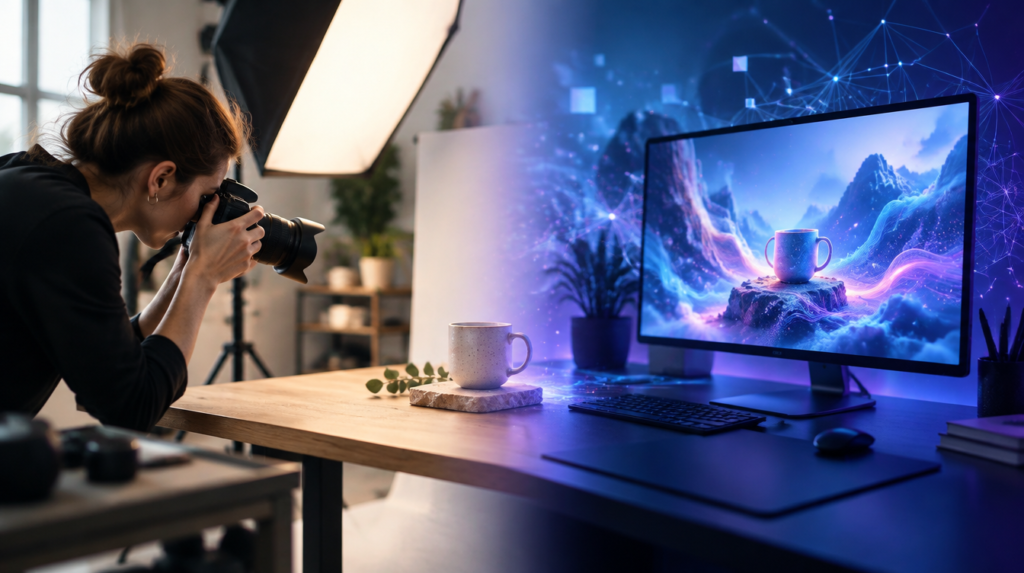
The Realness Problem:
AI-Driven Content vs. the Organic Photo Shoot
There’s a moment every business owner hits eventually, usually late at night, scrolling through a content calendar that’s three weeks out from being empty. The marketing team needs assets. The feed needs to keep moving. And somewhere in that scramble, a question starts to feel less theoretical and more urgent: do we generate this, or do we go shoot it?
At Trident Media Management, we sit inside that question constantly, because we work both sides of it every week. We build AI-generated visuals for clients who need volume, speed, and flexibility. We also plan, schedule, and personally show up to organic photo shoots — camera in hand, client on site, real light hitting a real face. Neither approach is a compromise. They solve different problems, and the businesses that win right now are the ones who understand which problem they actually have.
The Realism Question Isn’t Going Away
AI image generation has gotten remarkably good, and it keeps getting better by the month. But there’s still a tell, even when it’s subtle — a texture that’s slightly too smooth, a hand that’s almost right, a background element that doesn’t quite obey physics. Most people can’t articulate why an image feels off. They just feel it. That instinct matters more than most marketing plans account for, because trust is built in fractions of a second, and a viewer who senses something synthetic — even without knowing why — quietly discounts the message riding along with it.
This is where the tension actually lives. It’s not “AI content bad, real content good.” It’s that authenticity reads as credibility, and credibility is the currency every brand is spending down or building up with every post. A photo of your actual team, your actual space, your actual product in someone’s actual hands carries a kind of proof that no prompt can fully replicate yet. People aren’t just looking at the image. They’re looking for evidence that the business behind it is real, present, and doing the thing it says it does.
Why We Still Show Up With a Camera
That’s the case for the organic shoot, and it’s why we build time into client schedules to actually go capture live content — the storefront, the staff, the product on a table with the right light, the therapist’s office that a wellness client wants to feel warm instead of clinical. It takes more coordination. It takes more of the owner’s time and the client’s patience. But it produces something that functions as a kind of proof of life for the brand, and that proof compounds. One authentic shoot can seed months of content that all carries the same texture of truth, because it’s rooted in something that actually happened.
There’s also a strategic reason to protect this discipline as AI content becomes more common: scarcity value. As more of the internet fills with generated imagery, real, unmistakably human content starts to stand out simply by not looking synthetic. Businesses that keep a steady drumbeat of organic photography are quietly building a moat that’s harder to see than a logo or a tagline, but just as real.
Why AI Content Still Earns Its Place
None of that makes AI-generated content the lesser tool — it makes it a different tool. The honest advantage of AI is throughput. A concept, a season, a promotion, a product angle no one photographed yet, a visual idea that would cost thousands and take weeks to stage physically — AI can produce a usable version of that same day, at a fraction of the cost, and iterate on it in minutes when the first pass isn’t right. For a marketing team that needs to fill a calendar, test messaging, or respond to a trend before it’s dead, that speed isn’t a shortcut. It’s the only way the work gets done at the pace the market actually moves.
AI content also removes constraints that organic shoots simply can’t touch — weather, location access, model availability, budget for a full production day. It lets a brand visualize things that haven’t happened yet: a renovated space before construction is finished, a product in a setting no one’s actually shot it in, a concept ad testing an idea before committing real dollars to make it. Used this way, AI isn’t standing in for reality. It’s doing a job reality can’t do as fast or as cheaply.
Where the Line Actually Sits
The mistake we see most often isn’t using AI content — it’s using it in the wrong place. AI-generated visuals do well in concept work, ad testing, seasonal graphics, and stylized content where the audience already understands they’re looking at something crafted rather than documentary. They do poorly standing in for the things people expect to be real: the team, the physical space, the actual client experience, anything a customer might reasonably expect to see in person. Blur that line, and the cost isn’t just an awkward image. It’s a small, cumulative erosion of trust that’s much harder to earn back than it was to lose.
The businesses getting this right treat it as a portfolio decision, not a philosophical one. Real photography anchors the brand in fact. AI content extends that brand’s reach into ideas, speed, and volume that photography alone can’t sustain. One without the other leaves gaps — all AI and the brand starts to feel hollow; all organic and the marketing team can’t keep pace with what the calendar demands.
That’s the balance we build for clients at Trident: protect the moments that need to be real, and let AI carry the load everywhere speed and flexibility matter more than documentary proof. It’s not a trend to pick a side on. It’s a resource allocation problem, and treating it that way is what actually keeps a brand both credible and current.