
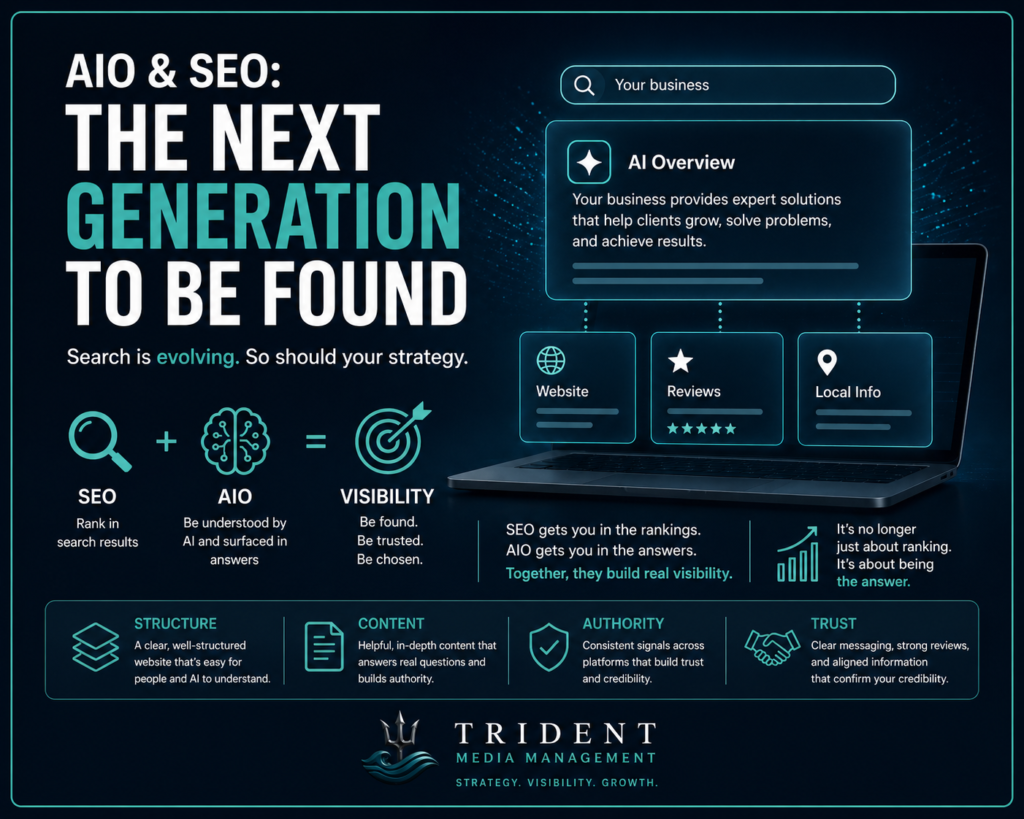
SEO Is Not Enough: The Next Evolution of Being Found Online
Most businesses still think being “found” online means ranking on Google.
That’s no longer enough.
Search has shifted. Not just in platform, but in behavior. People aren’t only typing queries into a search bar—they’re asking questions inside AI tools, scanning summaries, and making decisions before they ever click a traditional result.
That changes the game.
SEO Isn’t Dead — It’s Incomplete
SEO isn’t going away. But it’s no longer the full system. It’s one layer of a broader visibility framework that now includes how your business shows up in AI-generated answers, summaries, and recommendations.
That’s where AIO—AI Optimization—enters the conversation.
The mistake right now is treating AIO as something separate or experimental. It’s not. It’s an extension of what strong SEO was always supposed to do: make your business clear, structured, and authoritative enough to be understood and surfaced.
The difference is how that understanding happens.
From Ranking to Interpretation
Traditional SEO focused on keywords, rankings, and pages. It was about matching intent and earning position.
That still matters.
But AI doesn’t “rank” in the same way—it interprets. It pulls from structured information, consistent messaging, and credible signals to generate an answer.
If your business isn’t clearly defined across your website, your content, and your broader digital presence, AI doesn’t have anything reliable to pull from.
You don’t just rank lower—you disappear from the conversation entirely.
That’s the real risk.
The New Standard: Structured Visibility
The next generation of being found isn’t about chasing algorithms. It’s about building a system where your business is easy to understand, easy to trust, and easy to surface—whether that’s in search results or inside an AI response.
That starts with structure.
Your website has to do more than look good. It needs to communicate clearly: what you do, where you do it, and who you serve.
Service pages, location signals, and internal linking aren’t just SEO tactics anymore—they’re context for machines trying to interpret your business.
Content Has Changed Roles
Content is no longer about volume or keyword stuffing.
It’s about clarity and depth.
The businesses that will show up are the ones that consistently explain their expertise in ways that answer real questions. Not surface-level posts, but content that reflects how people actually think, search, and decide.
Consistency Is Now a Ranking Factor, Even If It’s Not Called That
Your Google Business Profile, your website, your social presence, your citations—they all need to align.
AI doesn’t rely on one source. It looks for patterns across multiple signals.
If your messaging is fragmented, your visibility will be too.
This is where most businesses fall short—not because they’re inactive, but because their efforts aren’t connected.
Where Most Systems Break
SEO without structure doesn’t hold.
Content without intent doesn’t surface.
A website without clarity doesn’t convert.
And now, without alignment, AI simply skips over you.
The Opportunity
The upside is significant.
Businesses that build this properly—structured websites, clear messaging, consistent signals, and intentional content—won’t just rank.
They’ll be referenced.
They’ll be surfaced in answers.
They’ll become part of the decision-making process before a user ever visits a page.
That’s a different level of visibility.
Final Thought
This isn’t about replacing SEO with AIO.
It’s about evolving SEO into something more complete.
Search is no longer just a destination. It’s part of a broader ecosystem of discovery, interpretation, and recommendation.
If your digital presence isn’t built to support that, you’re not just behind—you’re invisible in the places that are starting to matter most.
The businesses that adapt now won’t just keep up.
They’ll define how they’re found next.