
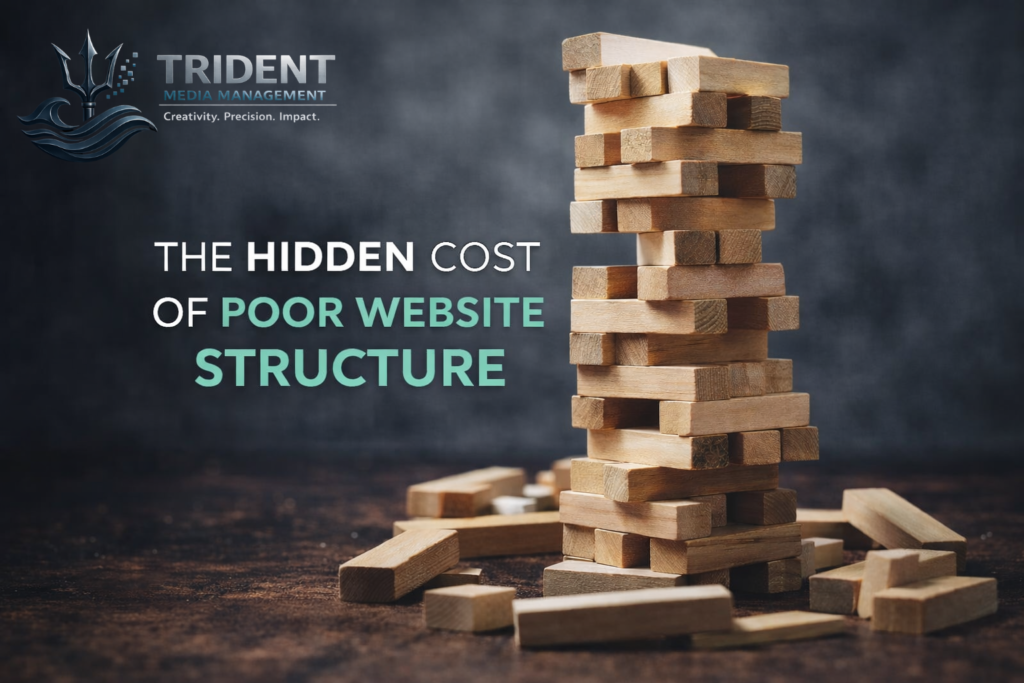
The Hidden Cost of Poor Website Structure
Most websites don’t struggle because of traffic. They struggle because of structure.
On the surface, everything appears active. Ads are running. Posts are being published. Analytics show movement. But underneath the activity is friction. Navigation is unclear. Messaging competes instead of aligns. Pages exist without purpose. And slowly, conversion begins to erode.
The cost isn’t immediate. It compounds.
Structure Determines Clarity
A website is not a collection of pages. It is a system. When that system lacks hierarchy, users have to think harder than they should. They scan without direction. They click without confidence. They leave without commitment.
Clear structure does three things:
It establishes priority.
It reinforces positioning.
It guides behavior.
Without those elements, even strong content loses effectiveness. A great service page buried under confusing navigation won’t perform. A strong value proposition diluted across multiple competing headlines won’t convert. Design cannot compensate for structural confusion.
Search Visibility Starts with Architecture
SEO doesn’t begin with keywords. It begins with organization.
Search engines evaluate structure the same way users do. Internal linking patterns, content hierarchy, URL logic, and semantic grouping all communicate intent. When pages are isolated or redundantly layered, authority disperses instead of concentrating.
This is why many businesses see impressions increase without seeing conversions rise. Traffic arrives at pages that aren’t designed to guide next steps. Content ranks without supporting pathways. Visibility exists, but growth does not.
Structure creates momentum. Disorganization creates leakage.
Friction Is Often Invisible
Poor structure rarely announces itself. It shows up in subtle metrics:
High bounce rates.
Short session durations.
Multiple clicks before action.
Inconsistent messaging across pages.
These are not marketing problems. They are architectural ones.
If users cannot quickly understand what you do, who you serve, and what to do next, no amount of optimization will compensate.
What Strong Structure Actually Looks Like
Strong structure feels quiet.
Navigation is intentional.
Services are grouped logically.
Headings build naturally.
Internal links support depth.
Calls-to-action align with user intent.
Users move forward without confusion. Search engines understand relationships between pages. Authority compounds instead of fragmenting.
When structure is strong, everything else performs better.
The Real Cost
The hidden cost of poor website structure isn’t just lost conversions. It’s lost leverage.
Every marketing effort becomes less efficient. Paid traffic converts lower. SEO takes longer to compound. Content requires more volume to achieve the same impact.
Structure determines whether growth accelerates or plateaus.
Most businesses don’t need more tactics. They need alignment.
Because architecture is not decoration.
It is strategy.