
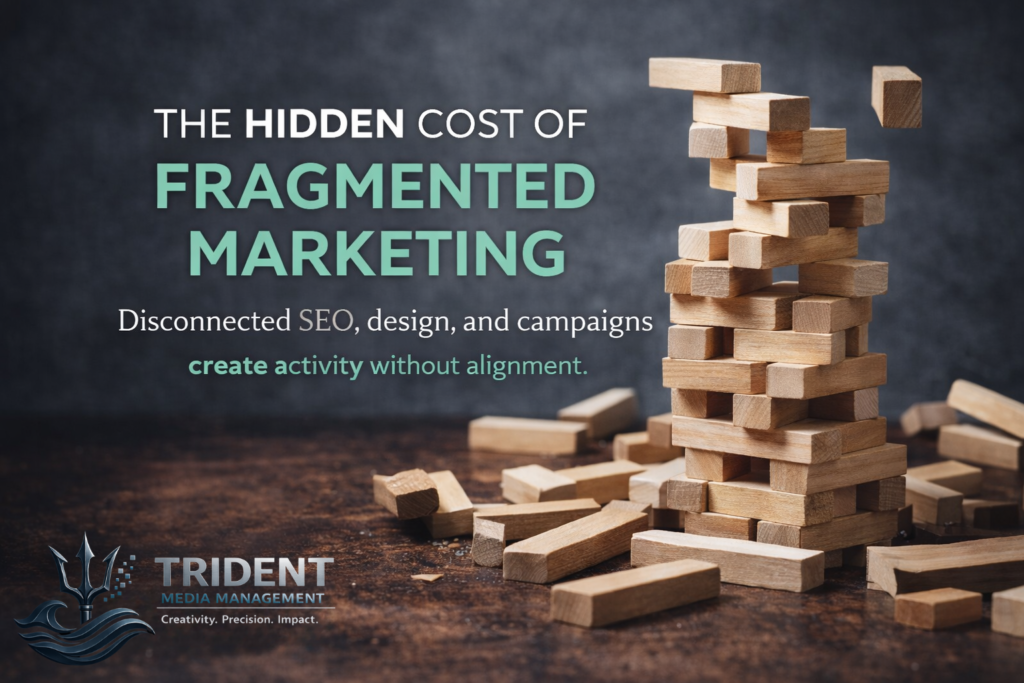
The Hidden Cost of Fragmented Marketing
Most marketing doesn’t fail because of poor effort. It fails because it is built in pieces.
A redesigned website here. A social media push there. An SEO campaign layered on top. Paid ads launched to “test traction.” Analytics installed after the fact. Each initiative may look productive in isolation. Together, they often create noise.
The problem isn’t activity. It’s fragmentation.
Activity Without Architecture
When marketing is built in fragments, there is no shared structure guiding it. Messaging evolves in one direction. Search optimization targets another. Paid traffic brings users to pages that weren’t built to convert. Analytics measure outcomes that were never clearly defined.
What looks like momentum is often just movement.
Without a unifying framework, every channel competes instead of compounds.
Search traffic grows but doesn’t convert.
Social engagement increases but doesn’t lead to inquiries.
Paid ads drive clicks but inflate acquisition costs.
The system is busy. The results are inconsistent.
Strategy Is Not a Layer — It’s the Foundation
Strategy cannot be applied after execution. It has to shape it.
Before optimizing a site, the positioning must be clear.
Before producing content, the audience must be defined.
Before driving traffic, the conversion path must be structured.
If those foundations are weak, optimization only amplifies confusion.
SEO will rank the wrong pages.
Ads will scale inefficient messaging.
Design will prioritize aesthetics over clarity.
Execution does not fix misalignment. It exposes it.
Integration Creates Leverage
Effective digital growth happens when the pieces reinforce one another.
Search informs content.
Content supports authority.
Authority improves rankings.
Rankings drive qualified traffic.
Analytics refine messaging.
Design supports conversion.
Each element strengthens the next.
This is what compounding looks like in digital marketing. Not spikes. Not viral moments. Structured momentum built through integration.
What Fragmentation Actually Costs
The real cost of fragmented marketing isn’t wasted budget. It’s diluted clarity.
Confused messaging weakens differentiation.
Disconnected systems weaken conversion.
Untracked decisions weaken iteration.
Over time, leadership begins to question whether “marketing works” at all.
In reality, the structure never worked.
Building Marketing as Infrastructure
Digital growth should be engineered like infrastructure — not assembled like a checklist.
Clear positioning.
Defined audience intent.
Search strategy aligned with messaging.
Site architecture built for conversion.
Analytics tied to business objectives.
When those elements are integrated from the start, growth becomes measurable. Predictable. Scalable.
Not because the tactics are clever. Because the system is aligned.
Most marketing underperforms not from lack of effort, but from lack of structure.
And structure is a strategic decision.